
ocr_stabilizer 3.0.0  ocr_stabilizer: ^3.0.0 copied to clipboard
Real-time OCR overlay stabilization engine — drift correction, spatial indexing, block tracking, CJK-aware paragraph grouping. Pure Dart; Flutter-ready.
ocr_stabilizer #
A real-time stabilization engine for live text-capture pipelines — OCR overlays and DOM/text extraction alike. It tracks text-block identity across noisy captures, corrects positional drift, and provides spatial indexing for deduplication: temporal association + geometric stabilization + spatial dedup of noisy text observations. Extraction streams are a first-line use case, not an afterthought — identity tracking, dedup and text voting are exactly what keeps an extraction pipeline consistent across re-captures, while the position-merge refinements matter most for rendered overlays.
Pure Dart — Flutter apps and server-side pipelines alike. No internal clock, no warm-up: a block is usable from its first observation; later captures only refine it (timing model).
The 2.x contract — what the package guarantees, what it deliberately
does not do, and what is yours to configure — is one page:
doc/CONTRACT.md.
Installation #
dependencies:
  ocr_stabilizer: ^3.0.0
Quick start #
DefaultTrackedBlock<T> is the fastest path — a concrete block with
documented defaults for every field the engine reads.
import 'package:ocr_stabilizer/ocr_stabilizer.dart';

final engine = StabilizationEngine<DefaultTrackedBlock<MyPayload>, MyPayload>(
  merger: (existing, fresh, merge) => existing.applyMerge(merge),
  // Every lever has a documented default; group overrides by stage:
  // config: StabilizerConfig(retention: RetentionConfig(missedFrames: 2)),
);

// Each capture (e.g. a screenshot on scroll-settle, 1–2 Hz):
final blocks = ocrResults.map((ocr) => DefaultTrackedBlock<MyPayload>(
  absoluteRect: ocr.absoluteRect,
  originalText: ocr.text,
  payload: ocr.payload,                               // opaque to the engine
  positionConfidence: PositionConfidence.from(ocr.posConf),
  textConfidence: TextConfidence.from(ocr.txtConf),
)).toList();

final result = engine.stabilize(blocks);
for (final block in result.stableBlocks) {
  // Render at first sight; re-observations only refine the box and text.
}
Runnable version: example/example.dart. Your own
block type: implement Track<T> — an Observation<T> (rect, frame, text,
confidences, payload: 7 getters) plus the engine-owned state (count, votes,
provisional status: 8 getters) — see the API reference.
Every stabilize() result also reports what the engine decided this
capture — a coherent shift, the identity turnover, a similarity-transform
estimate — so a layout layer can react without reverse-engineering
stableBlocks: observing the engine's decisions.

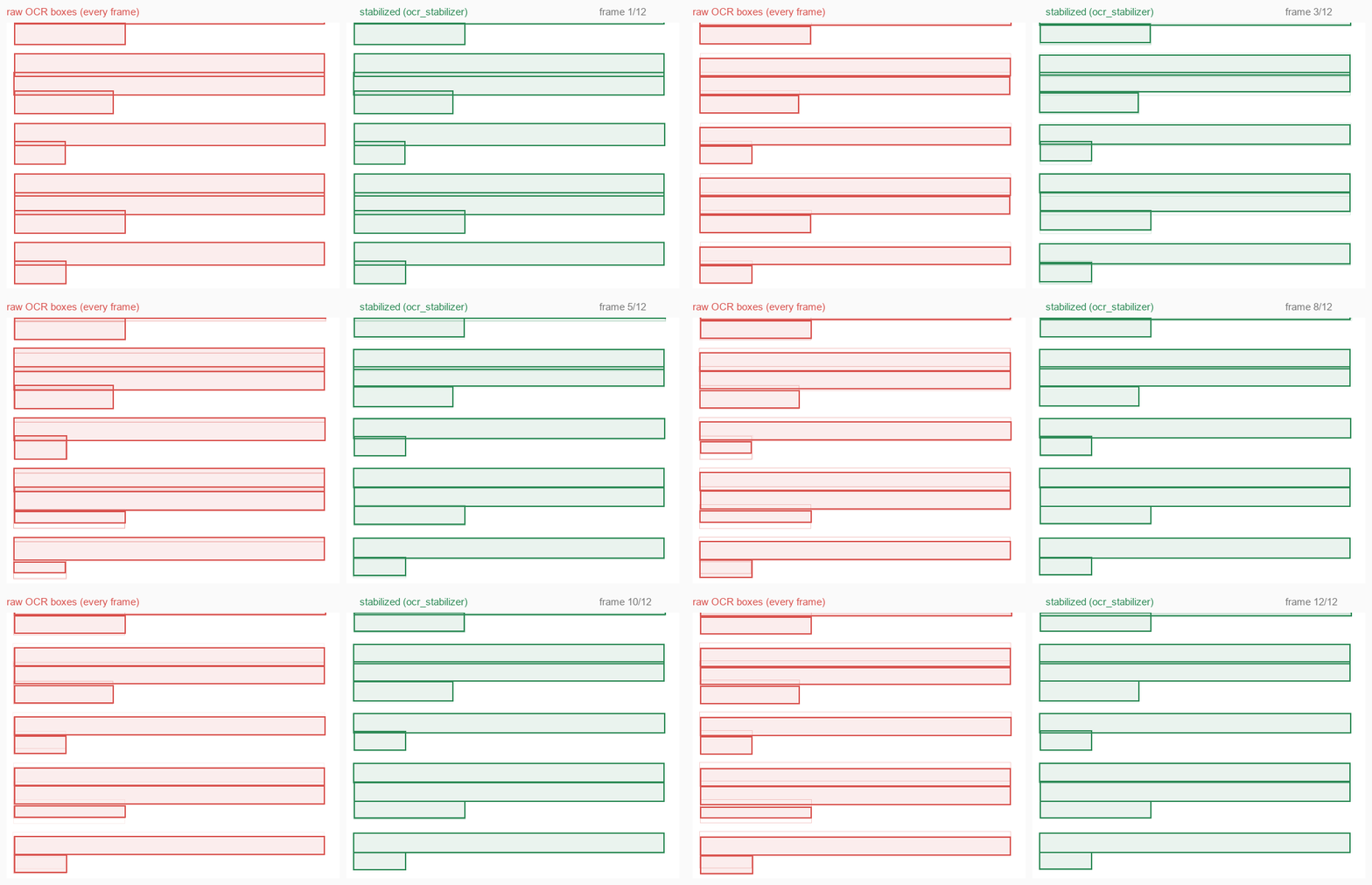
Real ML Kit output on a Galaxy S25 over a synthetic page (the
committed on-device corpus),
14 captures under scripted micro-scrolls, the same drawing rule on both
panels. Left: the boxes as the production pipeline reports them each
frame. Right: the engine's tracked state under StabilizationEngine
defaults plus missedFrameRetention: 2. Engine output, not an
illustration — rendered by
tool/replay/dump_frames.dart +
doc/media/render_demo_gif.py, and
test/demo_gif_provenance_test.dart pins the claim; the corpus entry
explains the remaining overlaps in the last frames. A
Tesseract twin
renders from the fully synthetic
cross-engine corpus.
How it works #
Live OCR on scrollable content produces a stream of noisy, jittery
observations: the same paragraph appears at slightly different positions
each capture, and without a stabilization layer overlays flicker,
duplicate and drift. Each stabilize() call:
- Dedups the capture — noise filter, position+text key dedup, spatial non-maximum suppression within the batch.
- Matches each fresh block to a tracked one — text similarity first, with an optional band-relaxed second pass for single-frame OCR flips (band fallback) and nested-fragment confirmation.
- Decides the step response — when a batch of blocks moves together
(a real layout reflow) the group re-anchors instead of being damped as
per-block jitter (
StepResponse.coherentShift, the default; calibration for the optional floor). - Merges — drift-corrected, agreement-weighted position merge; text and classification votes; position and text confidence.
- Retains or drops unmatched tracked blocks (
missedFrameRetention) and rebuilds the spatial index.
Observation counts are evidence depth, never a readiness ladder: nothing is withheld while evidence accrues (timing model).
Core components #
| Type | Purpose |
|---|---|
StabilizationEngine<T, P> |
The pipeline above; stabilize(blocks) per capture, or merge(fresh, existing) when you run your own matching |
Observation<T> / Track<T> |
What you supply per capture / what the engine keeps and returns |
DefaultTrackedBlock<T> |
Reference block with defaults, copyWith, applyMerge |
StabilizationResult<T> |
stableBlocks + coherentShift, identityTurnover, transformEstimate, contradictions |
DriftTracker |
Per-region drift correction (bounded to a line height, rolling window, submap isolation) |
SpatialBlockIndex |
Grid-cell candidate lookup; three coordinate-space namespaces |
ParagraphGrouper |
Downstream grouping into translation-sized units — not part of the identity model |
AbsoluteRect, ContainerId, SpaceKey, PositionConfidence, TextConfidence |
Zero-cost typed wrappers for coordinate and confidence safety |
Full tables — interfaces, components, result and value types, the
six-dimension identity model, hierarchy weights:
doc/API_REFERENCE.md.
Platform support #
The package is pure Dart (since 0.8.0) — no Flutter SDK required. It runs anywhere Dart runs: Flutter apps on every platform, server-side Dart, and CLI tools.
Geometry uses the package's own Rect / Offset / Size value types
(member-compatible with dart:ui's). Flutter apps convert at the render
boundary — the extensions below are all that's needed:
import 'dart:ui' as ui;
import 'package:ocr_stabilizer/ocr_stabilizer.dart';

extension RectToUi on Rect {
  ui.Rect toUi() => ui.Rect.fromLTRB(left, top, right, bottom);
}

extension UiToRect on ui.Rect {
  Rect toStabilizer() => Rect.fromLTRB(left, top, right, bottom);
}
Debug diagnostics are opt-in: pass debugLogger: print to
BlockClassifierService or DriftTracker (default is silent). Chatty
lines fire in debug builds only; anomaly-class events — non-finite input
skips, a throwing positionLookup callback — are delivered in every build
mode (#78).
The SubmapMembership and ClassificationInput interfaces let the engine
support different input sources:
| Platform | SubmapMembership | ClassificationInput |
|---|---|---|
| WebView | CssSubmapMembership (default) |
CaptureSnapshotAdapter (app-side) |
| Custom (page-based submaps) | Custom (page geometry) | |
| Camera | Custom (frame regions) | Custom (camera frame) |
Docs #
| Page | What it answers |
|---|---|
doc/CONTRACT.md |
The 2.x guarantees, intentionally unsupported cases, and consumer-configurable behaviours — each with its enforcing test or validation entry |
doc/API_REFERENCE.md |
Every public type, the six-dimension identity model, hierarchy weights |
doc/OBSERVING_DECISIONS.md |
Reading coherentShift, identityTurnover, transformEstimate from a layout layer |
doc/TIMING_MODEL.md |
Render at first sight, refine on re-sight |
doc/BAND_FALLBACK.md |
The band-relaxed second matching pass and its adoption flow |
doc/COHERENT_SHIFT_CALIBRATION.md |
The coherentShiftFloorPx recipe |
doc/DESIGN_DECISIONS.md |
Deliberate trade-offs and known limits, each with its tracking issue |
doc/RELEASE_NOTES.md |
The narrative "what's new" per version; the exact record is CHANGELOG.md |
doc/README.md |
Map of the validation entries (which engine, which numbers), benchmarks and the replay tool |
Contributing #
See CONTRIBUTING.md for dev setup, conventions, and the release flow.
Metadata
Documentation
Publisher
unverified uploader
Weekly Downloads
Metadata
Real-time OCR overlay stabilization engine — drift correction, spatial indexing, block tracking, CJK-aware paragraph grouping. Pure Dart; Flutter-ready.
Repository (GitHub)
View/report issues
Contributing
Topics
#ocr #overlay #tracking #slam #flutter
License
 MIT (license)