
flutter_feature_generator 2.0.1  flutter_feature_generator: ^2.0.1 copied to clipboard
A powerful code generator with web interface for creating clean architecture features in Flutter projects from OpenAPI/Swagger specifications.
Flutter Feature Generator #
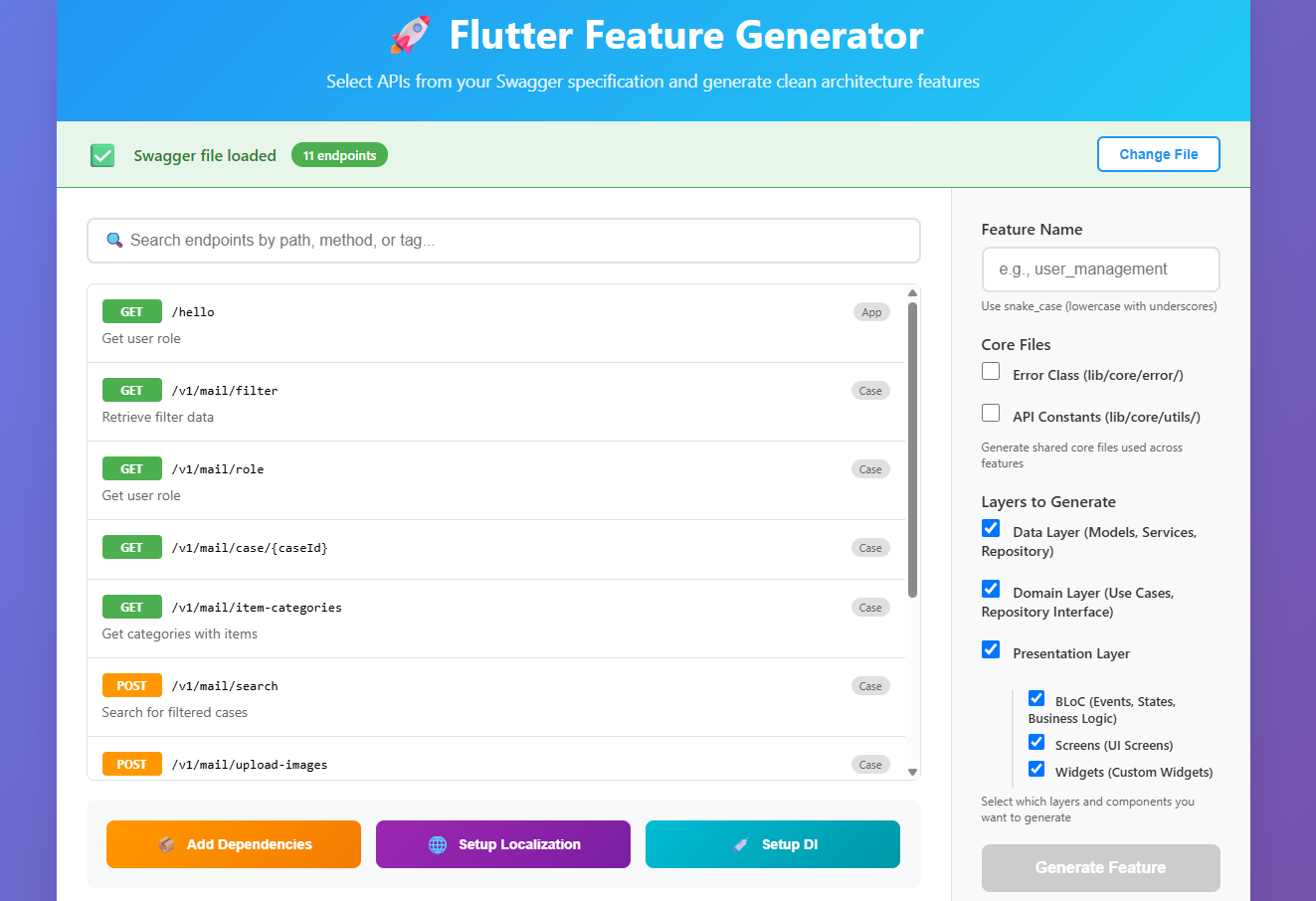
A powerful code generator with interactive web interface for creating clean architecture features in Flutter projects from OpenAPI/Swagger specifications.
✨ What's New in v2.0.0 #
🌐 Interactive Web Interface: Beautiful, modern web UI for selecting APIs and configuring generation 🎛️ Granular Layer Control: Choose exactly which layers to generate (Data, Domain, Presentation) 🧩 Presentation Components: Fine-grained control over BLoC, Screens, and Widgets 🔄 Smart Appending: Automatically appends to existing features instead of overwriting 📝 Consolidated Classes: Adds methods to existing classes instead of creating separate ones 🎯 Real-time Search: Filter APIs by path, method, tag, or description ✅ Multi-Selection: Select multiple endpoints with visual feedback
Features #
- 🌐 Modern Web Interface: Interactive UI for API selection and configuration
- 🏗️ Clean Architecture: Generates complete feature structure following clean architecture principles
- 📄 Swagger Integration: Automatically parses OpenAPI/Swagger specifications
- 🎛️ Granular Control: Choose specific layers and components to generate
- 🔄 Smart Appending: Add new APIs to existing features without overwriting
- 🎯 Interactive Selection: Multi-select APIs with search and filtering
- 📁 Flexible Structure: Configurable project structure and paths
- 🔒 Name Validation: Prevents conflicts with reserved folder names
- 📱 Responsive Design: Works on desktop and mobile browsers
Installation #
Global Installation (Recommended) #
dart pub global activate flutter_feature_generator
Local Installation #
Add to your pubspec.yaml:
dev_dependencies:
  flutter_feature_generator: ^2.0.0
Then run:
dart pub get
Usage #
Web Interface (New!) #
Start the interactive web interface:
# Run in your Flutter project root
flutter_feature_generator

# Or explicitly start web mode
flutter_feature_generator --web
Then open your browser and navigate to: http://localhost:8080
Web Interface Features:
- 🔍 Search & Filter: Find APIs by path, method, tag, or description
- ✅ Multi-Selection: Click to select/deselect multiple endpoints
- 🎛️ Layer Control: Choose which layers to generate:
- Data Layer: Models, Services, Repository Implementation
- Domain Layer: Use Cases, Repository Interface
- Presentation Layer: BLoC, Screens, Widgets (individually selectable)
- 📝 Smart Validation: Real-time feature name validation
- 🎯 Visual Feedback: Clear status messages and progress indicators
Command Line Interface #
For automation and scripting, you can still use the CLI:
# Show available endpoints and usage
flutter_feature_generator

# Generate feature with specific endpoints
flutter_feature_generator user_management 1,3,5

# Generate all endpoints
flutter_feature_generator api_features all
Layer Selection #
Choose exactly what you need:
Full Stack
- ✅ Data Layer
- ✅ Domain Layer
- ✅ Presentation Layer (BLoC + Screens + Widgets)
Backend Only
- ✅ Data Layer
- ✅ Domain Layer
- ❌ Presentation Layer
Business Logic Only
- ❌ Data Layer
- ✅ Domain Layer
- ✅ Presentation Layer (BLoC only)
UI Only
- ❌ Data Layer
- ❌ Domain Layer
- ✅ Presentation Layer (Screens + Widgets only)
Project Structure #
The generator creates features following this clean architecture structure:
lib/features/your_feature/
├── data/                          # Data Layer
│   ├── model/
│   │   ├── request_model.dart
│   │   └── response_model.dart
│   ├── remote/
│   │   ├── service/
│   │   │   └── your_feature_service.dart      # Retrofit API calls
│   │   └── source/
│   │       ├── your_feature_source.dart       # Data source interface
│   │       └── your_feature_source_impl.dart  # Data source implementation
│   └── repository/
│       └── your_feature_repository_impl.dart  # Repository implementation
├── domain/                        # Domain Layer
│   ├── repository/
│   │   └── your_feature_repository.dart       # Repository interface
│   └── usecase/
│       └── your_feature_usecase.dart          # Business logic
└── presentation/                  # Presentation Layer
    ├── bloc/                      # State Management
    │   ├── your_feature_bloc.dart
    │   ├── your_feature_event.dart
    │   └── your_feature_state.dart
    ├── screen/                    # UI Screens
    │   └── your_feature_screen.dart
    └── widget/                    # Custom Widgets
Smart Appending #
When you add new APIs to an existing feature, the generator intelligently:
- ✅ Adds methods to existing UseCases class
- ✅ Adds factory methods to existing freezed Event class
- ✅ Adds fields to existing freezed State class
- ✅ Adds handlers to existing BLoC class
- ✅ Adds methods to Repository interface and implementation
- ✅ Adds methods to Source interface and implementation
- ✅ Adds endpoints to Service class
- ✅ Generates missing models only
- ❌ Never overwrites existing code
Requirements #
- Dart SDK: >=3.0.0 <4.0.0
- A
swagger.jsonor OpenAPI specification file in your project root - Flutter project with standard structure
Required Dependencies #
The generated code uses several packages that must be added to your Flutter project:
dependencies:
  # Error handling with functional programming
  dartz: ^0.10.1

  # Dependency injection
  injectable: ^2.3.2
  get_it: ^7.6.4

  # Code generation for models and state management
  freezed_annotation: ^2.4.1
  json_annotation: ^4.8.1

  # HTTP client for API calls
  retrofit: ^4.0.3
  dio: ^5.3.2

dev_dependencies:
  # Code generation tools
  build_runner: ^2.4.7
  freezed: ^2.4.6
  json_serializable: ^6.7.1
  retrofit_generator: ^8.0.4
  injectable_generator: ^2.4.1
Package Explanations:
- 🎯 dartz: Provides
Either<Error, T>for functional error handling in use cases and repositories - 💉 injectable & get_it: Dependency injection for clean architecture - register your repositories and use cases
- 🧊 freezed: Generates immutable classes for models, events, and states with unions and pattern matching
- 🌐 retrofit & dio: HTTP client generation from your service interfaces - handles API calls automatically
- 🔧 json_annotation & json_serializable: Generates
fromJsonandtoJsonmethods for your models - ⚙️ build_runner: Runs code generation for all the above packages
Quick Setup #
Add the dependencies to your pubspec.yaml, then run:
# Install dependencies
flutter pub get

# Generate code (run this after generating features)
dart run build_runner build

# For development (watches for changes)
dart run build_runner watch
Configuration #
Swagger/OpenAPI File #
Place your API specification file (swagger.json or openapi.yaml) in your project root. The web interface will automatically load and parse it.
Feature Naming #
Feature names must follow snake_case format (e.g., user_management, chat_system).
Restricted Names (to prevent conflicts):
test,build,libandroid,ios,web,windows,linux,macos
Examples #
Web Interface Workflow #
-
Start the server:
flutter_feature_generator -
Open browser: Navigate to
http://localhost:8080 -
Select APIs: Use search and multi-select to choose endpoints
-
Configure layers: Select which components to generate
-
Set feature name: Enter a snake_case name (e.g.,
user_profile) -
Generate: Click "Generate Feature" and see real-time progress
CLI Workflow #
-
Show available APIs:
flutter_feature_generator -
Generate specific endpoints:
flutter_feature_generator user_management 1,3,5,7 -
Generate all endpoints:
flutter_feature_generator complete_api all
Generated Files Integration #
After generation, complete the integration:
-
Add required dependencies (see Requirements section above)
-
Generate build files:
dart run build_runner buildThis generates:
.freezed.dartfiles for models, events, and states.g.dartfiles for JSON serialization.config.dartfiles for dependency injection
-
Configure dependency injection in your
main.dart:@InjectableInit() void configureDependencies() => GetIt.instance.init(); void main() { configureDependencies(); runApp(MyApp()); } -
Register your repositories in a DI module:
@module abstract class AppModule { @injectable UserManagementRepository userRepo(UserManagementRepositoryImpl impl) => impl; } -
Use in your app: Import and use the generated components
Example BLoC usage:
BlocProvider(
  create: (context) => UserManagementBloc(
    GetIt.instance<UserManagementUseCases>(),
  ),
  child: UserManagementScreen(),
)
🎯 Auto-Generated Core Files #
The generator automatically creates these core files if they don't exist:
lib/core/error/error.dart: Functional error handling with freezed unions// Usage in your code result.fold( (error) => error.when( httpUnAuthorizedError: () => handleUnauthorized(), httpUnknownError: (message) => showError(message), // ... other error cases ), (data) => handleSuccess(data), );
Publishing to pub.dev #
To publish this package to pub.dev instead of onepub:
-
Remove onepub configuration:
# The publish_to line has been commented out in pubspec.yaml -
Commit and push changes to GitHub:
git add .
git commit -m "v2.0.0: Add web interface and core improvements"
git push origin master
Note: Images must be pushed to GitHub first for pub.dev to display them
-
Login to pub.dev:
dart pub login -
Dry run:
dart pub publish --dry-run -
Publish:
dart pub publish
📸 Image Display Note #
For images to show on both GitHub and pub.dev:
- Local paths work on GitHub:
 - Absolute URLs work on pub.dev:

This README uses absolute GitHub URLs so images display properly on pub.dev.
Contributing #
- Fork the repository
- Create your feature branch (
git checkout -b feature/amazing-feature) - Commit your changes (
git commit -m 'Add some amazing feature') - Push to the branch (
git push origin feature/amazing-feature) - Open a Pull Request
License #
This project is licensed under the MIT License - see the LICENSE file for details.
Changelog #
See CHANGELOG.md for a list of changes in each version.
Made with ❤️ for the Flutter community
Metadata
Publisher
unverified uploader
Weekly Downloads
Metadata
A powerful code generator with web interface for creating clean architecture features in Flutter projects from OpenAPI/Swagger specifications.
Homepage
Repository (GitHub)
View/report issues
Documentation
License
 unknown (license)
Dependencies
args, path, shelf, shelf_router, shelf_static

