
fcheck 1.1.2  fcheck: ^1.1.2 copied to clipboard
 vteam.com
Code quality analysis for Flutter and Dart projects with architecture, maintainability, and safety checks, deterministic reports, and compliance scoring.
fCheck #
fCheck provides fast local quality analysis for Flutter and Dart projects with 0-100% compliance scoring. Single analysis pass covering architecture, maintainability, and safety issues beyond standard linting, with deterministic CLI/JSON reports for CI/CD pipelines and fully private execution: it does not require any AI service, no network calls are needed, and no source code is sent to external services.
Why fCheck #
- Single local run for multiple quality domains
- Deterministic output for CI and code review
- 100% private local execution (no AI service, no code sent externally)
- Console, JSON, and diagram outputs
- Includes test discovery metrics (
hasTests,testDirectories,testFiles,testDartFiles,testCases) - Works as a CLI tool
- Works as a Dart package in your own app/tooling
Checks Included #
code_sizedead_codedocumentationduplicate_codehardcoded_stringslayerslocalizationmagic_numbersone_class_per_filesecretssource_sorting
Detailed behavior and edge cases are documented in RULES*.md.
Hardcoded strings: how it works #
-
Flutter projects use opt-out hardcoded-string detection: most string literals are analyzed by default, then technical, diagnostic, declaration, and framework-specific cases are excluded.
-
If project localization is
OFF, hardcoded-strings runs in passive mode ([-]), reports only the total count, and does not affect compliance score/focus area. -
If project localization is
OFF, hardcoded-string findings are also excluded from SVG warning tint/counters (fcheck_files.svg,fcheck_folders.svg,fcheck_loc.svg). -
If localization is
ON, hardcoded-strings is active and reports detailed issue entries. -
Flutter projects: fcheck scans most string literals, then skips known non-user-facing categories such as imports, annotations, const declarations, explicit typed
Stringdeclarations used as reusable identifiers/constants, localization calls, generated files, logger/debug output,throwdiagnostics,toString()bodies, technical strings, paths, URLs, query strings, lookup keys, and similar infrastructure values. -
Dart projects: fcheck keeps a narrower focus and primarily reports strings passed to
print(). -
Localization-aware behavior still applies:
- localization
OFF: summary count only, passive mode - localization
ON: detailed issue list
- localization
Hardcoded strings: what to do with findings #
- Move repeated UI copy into named constants when the text is internal to the codebase and not part of a localization workflow.
- Move user-facing product text into your localization system (
.arb,AppLocalizations, or equivalent) when the app already supports localization or is expected to. - Keep technical strings technical: paths, route fragments, query strings, identifiers, analytics keys, backend field names, logger text, exception diagnostics, and reusable typed declarations should remain non-user-facing and are increasingly auto-excluded by fcheck.
- Prefer a named constant even when localization is not needed. A constant gives one source of truth, reduces typo drift, simplifies refactors, and makes intent obvious during review.
Hardcoded strings: industry best practice #
- Avoid scattering raw literals through business logic, widgets, services, and backend adapters.
- Use
constwhere possible for stable reusable values. - Use typed named declarations for reusable non-localized identifiers.
- Use localization for customer-facing copy instead of embedding text inline.
- Treat every new hardcoded-string finding as a clean-code prompt: either extract it, localize it, or explicitly justify and suppress it.
Hardcoded strings: opt out and suppression #
- Disable the analyzer globally in
.fcheck:
analyzers:
  disabled:
    - hardcoded_strings
- Use opt-in mode and omit
hardcoded_strings:
analyzers:
  default: off
  enabled:
    - magic_numbers
    - secrets
- Suppress a specific source line or file only when the literal is intentionally technical/non-user-facing:
// ignore: fcheck_hardcoded_strings
final debugLabel = 'ContactsNotifier';
Use suppression sparingly. The preferred path is to extract or localize the string rather than silence the rule.
Localization: how it works #
- fCheck automatically detects when a project uses Flutter localization and analyzes translation completeness.
- Scans for ARB files (
.arb) inlib/l10n/directory and analyzes translation coverage across all supported languages. - Falls back to any project ARB files when
lib/l10n/has none, and prefers English as the base language when available. - Identifies missing translations by comparing each language file against the base language.
- Reports coverage percentage and missing translation count for each incomplete language.
- Supports common ARB file naming patterns:
app_en.arb,messages_es.arb,l10n_fr.arb, etc. - Supports locale variants such as
app_pt_BR.arbandapp_zh_Hans.arb. - Handles metadata keys (starting with
@or@@) appropriately by excluding them from translation analysis. - Respects
@key.descriptionhints such asDO NOT TRANSLATE,ignore, orreviewedin either the base ARB or translated ARB and excludes those keys from coverage checks. - Treats empty strings, untranslated copies, and placeholder mismatches as incomplete translations.
- Warns on duplicate top-level ARB keys so overwritten entries do not go unnoticed.
- Warns when an English base-locale key exists in ARB but is never referenced from app Dart source under
lib/, helping catch orphan/dead strings.
Localization: what it reports #
For each language with incomplete translations:
- Language code (e.g., 'es', 'fr', 'de')
- Language display name (e.g., 'Spanish', 'French', 'German')
- Number of missing translations
- Total number of strings in base language
- Coverage percentage (0.0% to 100.0%)
Localization: best practices #
- Ensure all user-facing strings are translated before releasing new features.
- Use descriptive keys in ARB files to maintain translation context.
- Regularly review translation completeness, especially when adding new features.
- Consider using translation management tools for large-scale projects.
- Test your app with different locales to ensure proper fallback behavior.
Localization false positives #
Use the localization guidance from fcheck --help-ignore to handle findings that are intentional or project-specific:
- Intentional identical text or brand names: add ARB metadata such as
@key.description: "reviewed"orDO NOT TRANSLATE - Expected non-translations: use
ignorein the key description when you want fCheck to skip the entry - Duplicate keys: fix the ARB file so each top-level key appears only once; the analyzer warns because later entries overwrite earlier ones
- Placeholder drift or empty strings: correct the translation, do not suppress unless the value is intentionally exempted
- Unused English keys: remove orphan ARB entries that are no longer referenced from app code, or wire the key back into the UI if it is still needed
Example:
"anapayTitle": "anapay",
"@anapayTitle": {
  "description": "reviewed"
}
Code-size LOC note:
- Localization Dart files are excluded from LOC code-size evaluation (
lib/l10n/**,app_localization.dart,app_localizations.dart, and generated locale variants such asapp_localizations_<locale>.dart).
Install #
Option 1: Global CLI #
dart pub global activate fcheck
fcheck .
Option 2: Project Dev Dependency #
dart pub add fcheck -d
dart run fcheck .
Option 3: Use as a Dart package in your app/tool #
dart pub add fcheck
import 'dart:io';
import 'package:fcheck/fcheck.dart';

void main() {
  final metrics = AnalyzeFolder(Directory('.')).analyze();
  print('Score: ${metrics.complianceScore}%');
}
Quick Start (CLI) #
# Analyze current folder
fcheck .

# Analyze another folder
fcheck ../my_app
fcheck --input ../my_app

# JSON output
fcheck --json

# Full list output
fcheck --list full

# Generate diagrams
fcheck --svg --mermaid --plantuml

# Auto-fix source sorting issues (class members + import directives)
fcheck --fix
What --fix does #
- Rewrites Dart source files in place.
- Applies only
source_sortingauto-fixes:- Reorders Flutter widget class members to match fCheck sorting rules.
- Reorders
importdirectives with these groups:dart:*- all
package:*imports (includingflutterand your own package), alphabetical - other absolute URIs (for example
http:) - relative imports
- Inserts one blank line between import groups.
- Rewrites relative imports that resolve under
lib/topackage:<this-package>/....
- Does not auto-fix other analyzers; it only reports their issues.
Sample Bash Output #
$ fcheck .
↓------------------------------ fCheck 1.1.2 -------------------------------↓
Input              : /path/to/project
Dart Project       : my-cool-app (version: 9.0.0)
Platforms          : [✓Android] [✓iOS]  [✓MacOS] [✓Windows] [✓Linux]   [✓Web]
--------------------------------- Dashboard ---------------------------------
Dependencies       :               5  |  DevDependencies    :               2
Folders            :              21  |  Classes            :              66
Files              :             120  |  Widgets: Stateful  :              26
Excluded Files     :              39  |  Widgets: Stateless :              40
Dart Files         :              91  |  Methods            :             357
Lines of Code      :       15.0 KLoC  |  Functions          :             179
Comments           :     2,145 (14%)  |
----------------------------------- Tests -----------------------------------
Test Dart Files    :              35  |  Touched Dart Files :         41 (45%)
Test Cases         :             392  |  Touched Classes    :         31 (47%)
                                      |  Touched Methods    :        144 (40%)
                                      |  Touched Functions  :         73 (41%)
--------------------------------- Literals ----------------------------------
Strings            : 1,203 (64% dupe)
Numbers            :   842 (74 hardcoded)
--------------------------------- Analyzers ---------------------------------
[✓] Checks bypassed
[✓] Code size
[✓] Dead code
[✓] Documentation
[✓] Duplicate code
[✓] Hardcoded strings
[✓] Layers architecture
[✓] Localization  : OFF
[✓] Magic numbers
[✓] One class per file
[✓] Secrets
[✓] Source sorting
--------------------------------- Scorecard ---------------------------------
Total Score        : 100%
Invest Next        : Maintain this level by enforcing fcheck in CI on every pull request.
↑------------------------ fCheck completed (1.73s) -------------------------↑
The Touched ... rows are a static inventory derived from test-file imports plus transitive project-local Dart dependencies. They indicate source reached by test dependency graphs, not code coverage.
Configuration (.fcheck) #
Create .fcheck in the input directory (--input) or current directory.
input:
  root: app
  exclude:
    - "**/generated/**"
    - "**/*.g.dart"

analyzers:
  default: on
  disabled:
    - hardcoded_strings
    - source_sorting
  options:
    duplicate_code:
      similarity_threshold: 0.85 # 0.0..1.0
      min_tokens: 20
      min_non_empty_lines: 10
    code_size:
      max_file_loc: 900
      max_class_loc: 800
      max_function_loc: 700
      max_method_loc: 500
Notes:
analyzers.defaultacceptson|offandtrue|false- Opt-in mode:
analyzers:
  default: off
  enabled:
    - magic_numbers
    - secrets
- Config precedence: built-in defaults <
.fcheck< CLI flags input.rootis resolved relative to the.fcheckfile location--excludeadds patterns on top of.fcheckinput.exclude
Ignore Directives #
Use top-of-file or line-level ignore directives:
// ignore: fcheck_dead_code
// ignore: fcheck_documentation
// ignore: fcheck_duplicate_code
// ignore: fcheck_hardcoded_strings
// ignore_for_file: avoid_hardcoded_strings_in_widgets
// ignore: fcheck_layers
// ignore: fcheck_magic_numbers
// ignore: fcheck_one_class_per_file
// ignore: fcheck_secrets
CLI help to guide you on how to exclude some of checks
fcheck --help-ignore
Dead-code note:
// ignore: fcheck_dead_codesuppresses dead-code findings for that file's declarations, while keeping its dependencies/usages in global dead-code analysis.- Dead-code usage tracking includes property-style getter/setter access and operator usage (
+,-,[], etc.) inferred from expression syntax. - Functions/methods annotated with
@Preview(including prefixed forms such as@ui.Preview) are treated as externally used and are not reported as dead functions.
Visual Outputs #
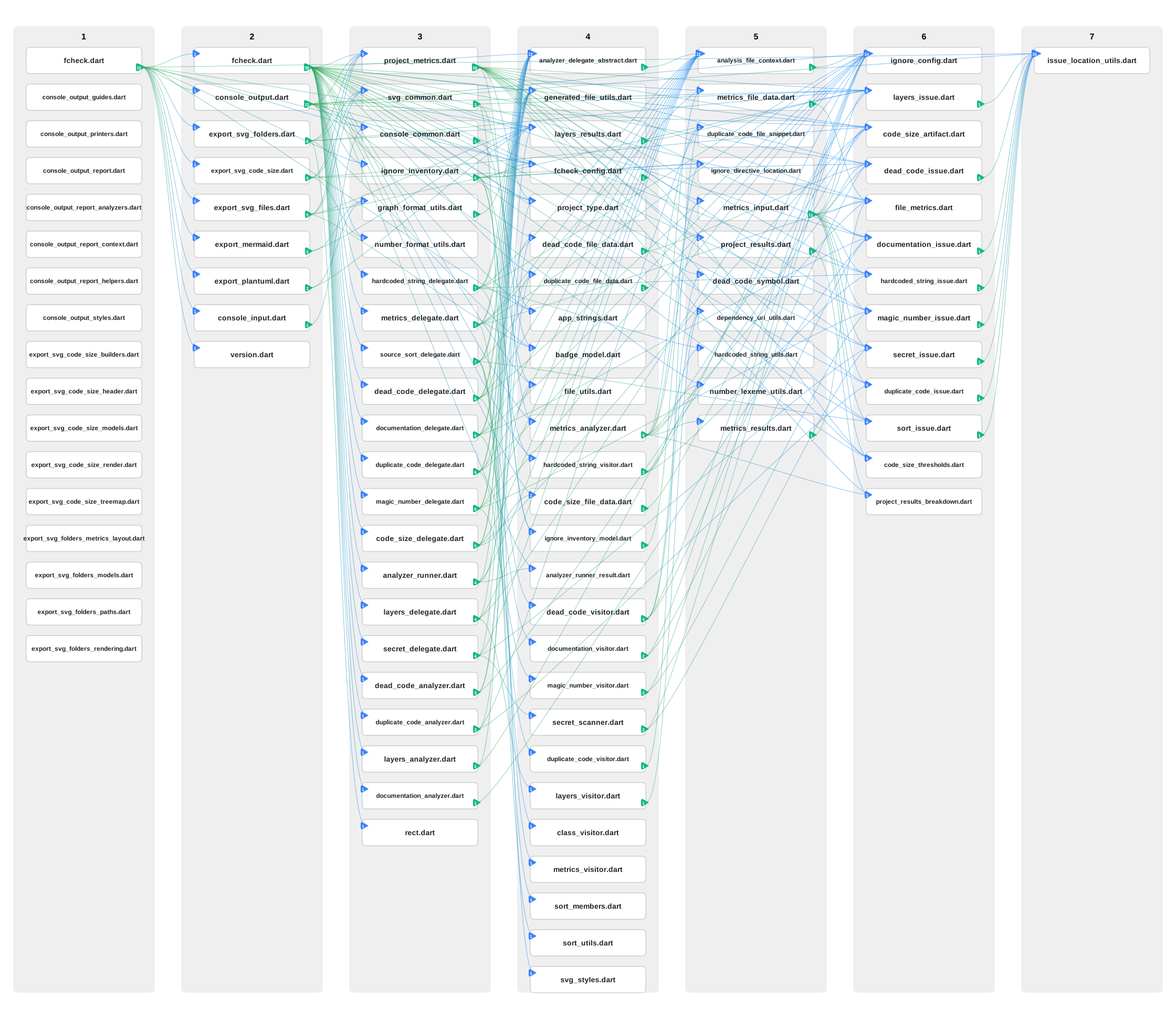
Adjacent file-level SVG routing rule for nodes on the same row in adjacent columns:
- If the source node has exactly one outgoing edge, the edge is rendered as a straight line.
- If the source node has multiple outgoing edges, the same-row adjacent edge is rendered as a single arch (no elbows).
fcheck --svg          # shortcut: fcheck_files.svg + fcheck_folders.svg + fcheck_loc.svg
fcheck --svg-files    # fcheck_files.svg
fcheck --svg-folders  # fcheck_folders.svg
fcheck --svg-loc      # fcheck_loc.svg
fcheck --mermaid      # fcheck.mmd
fcheck --plantuml     # fcheck.puml

# Custom output base directory
fcheck --svg --mermaid --plantuml --output ./reports/fcheck

# Per-artifact file overrides
fcheck --svg --output-svg-files ./artifacts/graph/files.svg
fcheck --svg-folders --output-svg-folders ./artifacts/graph/folders.svg
fcheck --svg-loc --output-svg-loc ./artifacts/graph/loc.svg
fcheck --mermaid --output-mermaid ./artifacts/graph/fcheck.mmd
fcheck --plantuml --output-plantuml ./artifacts/graph/fcheck.puml
Layers Files diagram #
Layers Folder diagram #
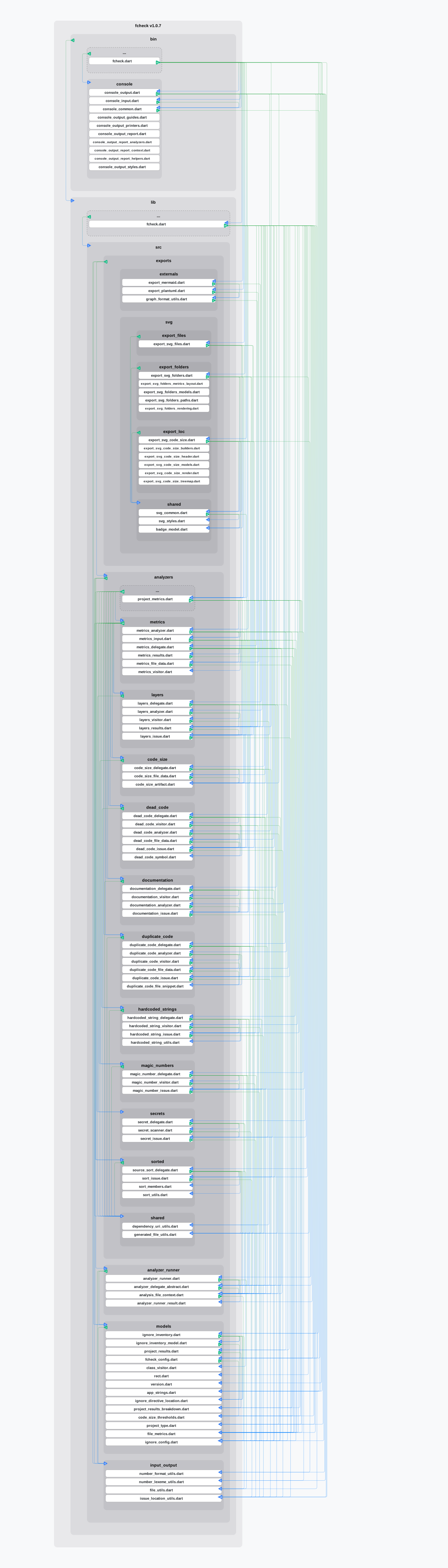
Orange upward dependencies in fcheck_folders.svg are rendered from the final visual direction. Folder-level upward edges are also emitted in CLI report output as layers warnings (wrongFolderLayer) with the source Dart file path. File-level upward edges on the right lane stay orange even inside folder cycles so the culprit consuming files remain easy to spot.
Warning/error-highlighted file and folder nodes in layers SVGs now use a softer transparent gradient tint (instead of opaque flat fills) to preserve node text/details readability.
Code size diagram #
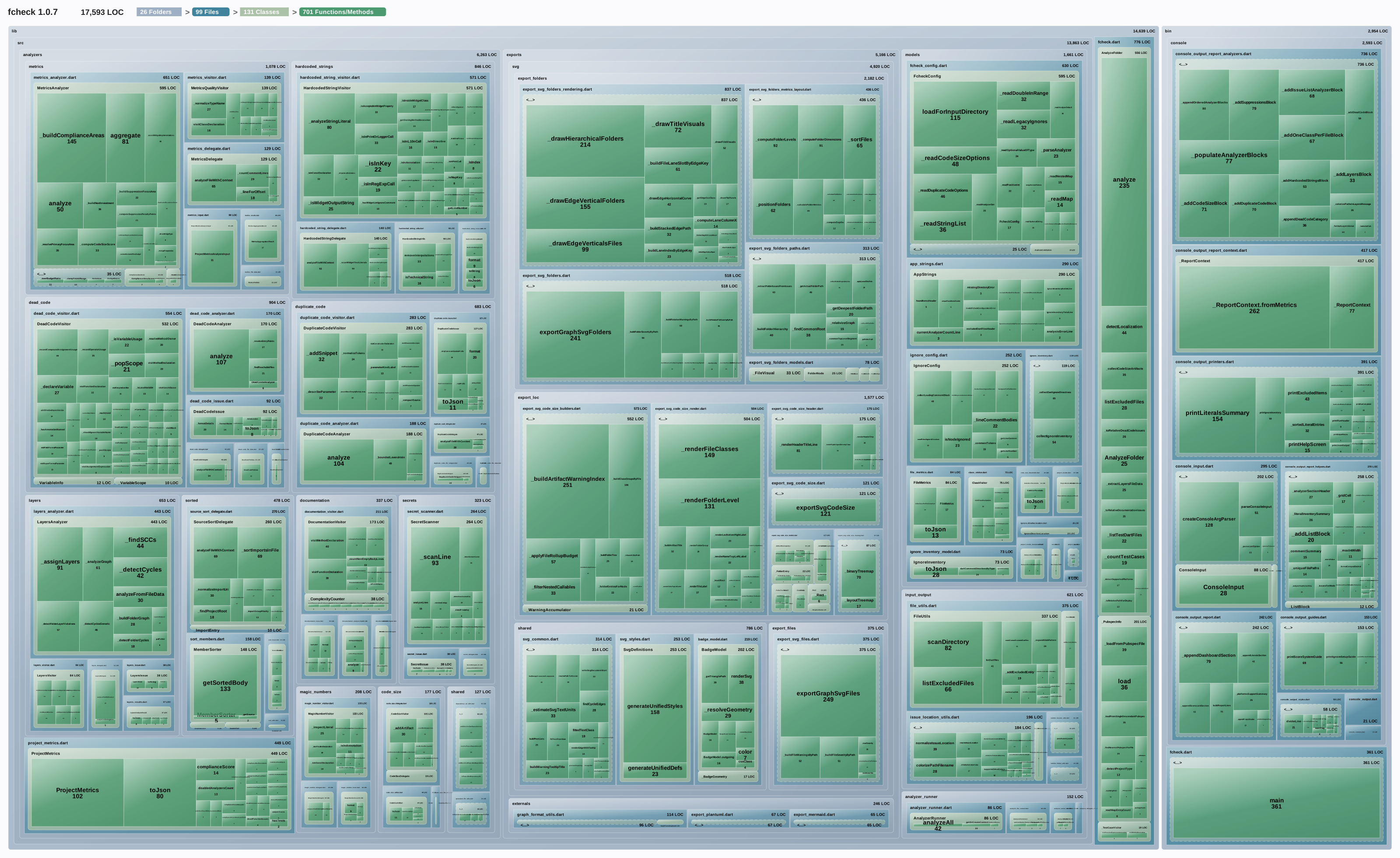
fcheck_loc.svg uses a unified treemap hierarchy:
Folders > Files > Classes > Functions.
Warning highlighting in fcheck_loc.svg:
- Artifacts with analyzer findings are tinted on a red transparency spectrum (low warnings => light pink, high warnings => stronger red).
- Dead artifacts are treated as maximum severity tint.
- SVG tooltips include warning counts and sampled issue details for each affected file/class/function tile.
Exclusions #
# Add custom excludes
fcheck --exclude "**/generated/**" --exclude "**/*.g.dart"

# Inspect excluded items
fcheck --excluded
fcheck --excluded --json

# Inspect ignore/suppression inventory (.fcheck + Dart directives)
fcheck --ignores
fcheck --ignores --json

# Inspect literals inventory only
fcheck --literals
fcheck --literals --json
--ignores groups results by suppression type (exclude, analyzer skips, and Dart comment directive type) so cleanup work can be prioritized.
--literals full list text output od all the literals in your project.
Default exclusion behavior includes hidden folders and common non-analysis directories (.git, .dart_tool, build, example, test, integration_test, platform folders, etc.).
Generated Dart files ending with *.g.dart are analyzed for dependency/usage flow, but non-actionable checks are suppressed (for example code size, one-class-per-file, dead-code declarations, hardcoded strings, magic numbers, sorting, duplicate code, and documentation).
CI Example (GitHub Actions) #
name: CI
on:
  pull_request:
  push:
    branches: [main]

jobs:
  quality:
    name: Build, test, and self-check (100%)
    runs-on: ubuntu-latest
    steps:
      - uses: actions/checkout@v4
      - uses: subosito/flutter-action@v2
        with:
          channel: stable
      - run: flutter pub get
      - run: ./tool/generate_version.sh
      - run: dart format --output=none --set-exit-if-changed .
      - run: flutter analyze lib test --no-pub
      - run: dart test --reporter=compact
      - run: dart run ./bin/fcheck.dart --json --exclude "**/example" . > fcheck-report.json
      - run: |
          score="$(grep -oE '"complianceScore"[[:space:]]*:[[:space:]]*[0-9]+([.][0-9]+)?' fcheck-report.json | head -n1 | sed -E 's/.*:[[:space:]]*//')"
          score_int="$(awk "BEGIN { printf \"%d\", ${score} }")"
          test "$score_int" -eq 100
      - uses: actions/upload-artifact@v4
        with:
          name: fcheck-report
          path: fcheck-report.json
This repository already includes this workflow at .github/workflows/ci.yml.
The CI gate fails unless fcheck's self-analysis score is exactly 100%.
License #
MIT
Metadata
Documentation
Publisher
Weekly Downloads
Metadata
Code quality analysis for Flutter and Dart projects with architecture, maintainability, and safety checks, deterministic reports, and compliance scoring.
Repository (GitHub)
View/report issues
Topics
#analysis #architecture #code-style #lint #compliance
License
 MIT (license)
Dependencies
analyzer, args, glob, path, yaml

