
domain_error 5.0.3  domain_error: ^5.0.3 copied to clipboard
Domain errors with Result, DomainResult, and captureResult for expected errors in Dart applications.
domain_error #
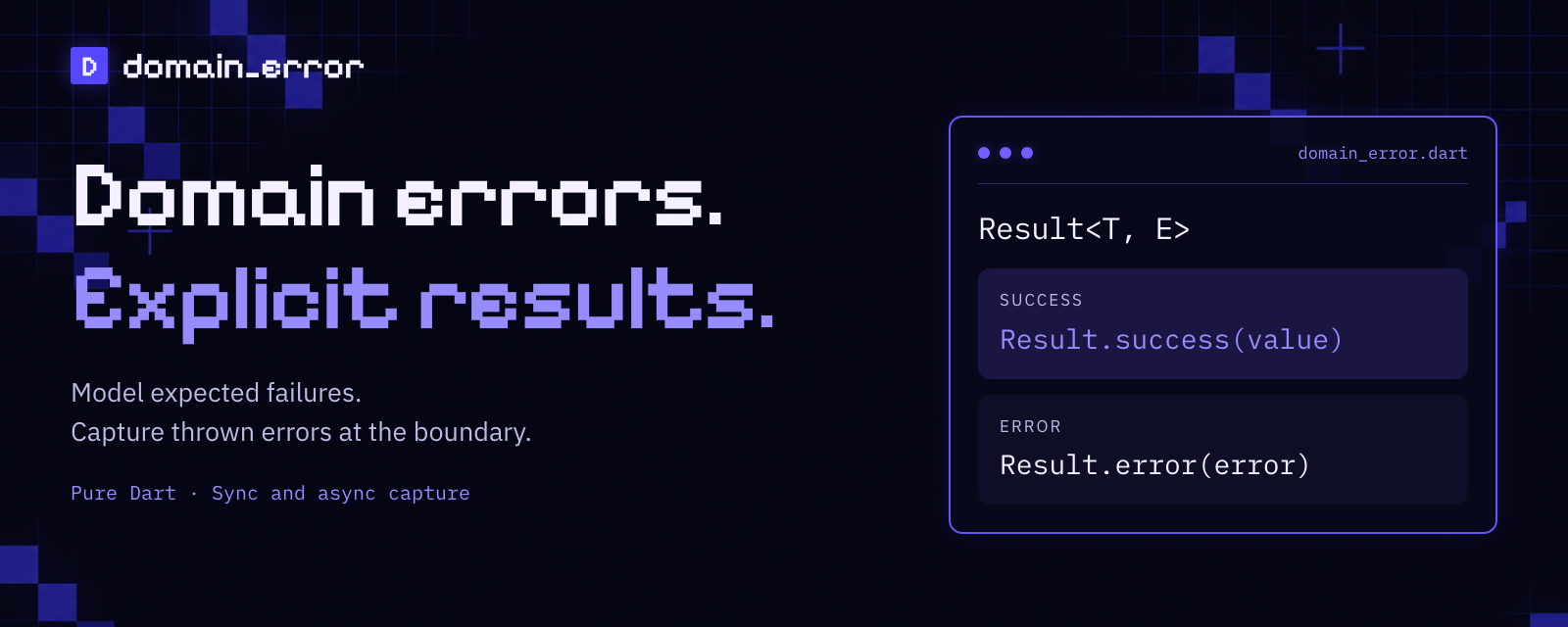


Domain errors and explicit operation results for Dart and Flutter. Model an
expected failure with DomainError, capture a throwing operation at its boundary,
and handle or compose its Result without nested try/catch blocks.
The package is pure Dart. It has no Flutter SDK dependency and does not choose state management, logging or application layers for you.
Contents #
- When to use it
- Install
- Quick start
- Model domain errors
- Capture operations
- Handle results
- Compose operations
- Exceptions and asynchronous boundaries
- Equality and mutable payloads
- Diagnostics and reporting
- API map
- Compatibility
- Migrate to 5.x
- Package skill
- Development
- License
When to use it #
Use a domain error when a caller needs to distinguish an expected application outcome, such as an empty order ID, an unavailable order or a rejected order. A feature-specific error hierarchy lets the caller make that decision without parsing exception messages.
Use Result<T, E> when an operation returns either a value of T or an error of
E. The error can be any type. DomainResult<T> specializes it to DomainError;
FutureDomainResult<T> is Future<DomainResult<T>>.
Use capture at a boundary where a throwing operation should become a domain result. Map other thrown objects into your vocabulary there. Keep that mapping selective so programming failures are not silently presented as expected outcomes. An ordinary return value or exception remains appropriate when the caller does not need a result value to inspect or compose.
Capture handles an operation and its returned future. Composition transforms existing result values. The package supplies no retries, cancellation, parallel execution, stream operator, logger or reporting integration.
Install #
dart pub add domain_error
# In a Flutter project:
flutter pub add domain_error
Or add this dependency:
dependencies:
  domain_error: ^5.0.0
Import package:domain_error/domain_error.dart. Use the public import for all
types and extensions; internal src paths are not separate supported entry points.
Requires Dart >=3.0.0 <4.0.0. See compatibility for the tested
Dart and Flutter endpoints.
Quick start #
Every Dart block in this README is an independent program. Save one as
bin/example.dart in a project with the dependency, then run
dart --enable-asserts run bin/example.dart. This program prints Order 42.
import 'package:domain_error/domain_error.dart';

/// Converts an unavailable order into the application's error vocabulary.
final class OrderUnavailableError extends DomainError {
  const OrderUnavailableError({
    super.cause,
    super.stackTrace,
  });

  @override
  String get typeIdentifier {
    return 'OrderUnavailableError';
  }
}

Future<void> main() async {
  final result = await captureResult<int>(
    () async {
      return 42;
    },
    mapToDomainError: (error, trace) {
      return OrderUnavailableError(
        cause: error,
        stackTrace: trace,
      );
    },
  );

  final description = result.fold(
    (error) {
      return error.typeIdentifier;
    },
    (value) {
      return 'Order $value';
    },
  );

  assert(description == 'Order 42');
  print(description);
}
example/domain_error_example.dart
contains a larger order-loading example with success, domain errors, timeouts
and other thrown objects.
Model domain errors #
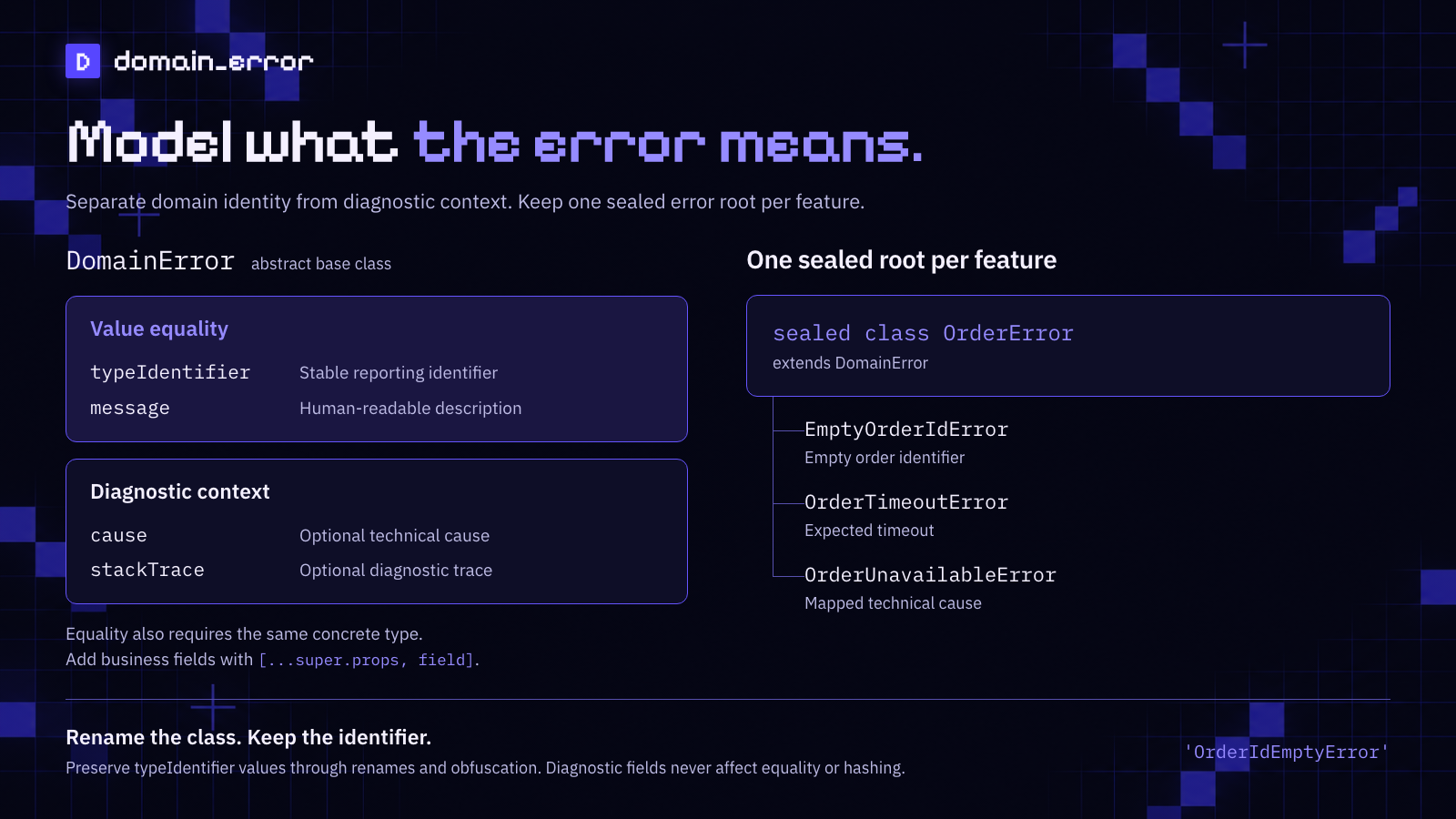
Extend DomainError in your own library. A sealed feature root groups related
outcomes while allowing exhaustive handling within your application's model.
Set typeIdentifier explicitly. Preserve the string when renaming the Dart class;
for example, EmptyOrderIdError can retain the identifier OrderIdEmptyError.
Runtime type names and hash codes are not stable identifiers.
By default, equality includes the concrete error type, typeIdentifier and
message. Diagnostic cause and stackTrace do not participate. Include business
fields through props, preserving super.props:
import 'package:domain_error/domain_error.dart';

/// Groups order failures without prescribing an application architecture.
sealed class OrderError extends DomainError {
  const OrderError({
    super.message,
    super.cause,
    super.stackTrace,
  });
}

/// The rejection reason is business data and participates in equality.
final class OrderRejectedError extends OrderError {
  final String reason;

  const OrderRejectedError({
    required this.reason,
    super.message,
    super.cause,
    super.stackTrace,
  });

  @override
  String get typeIdentifier {
    return 'OrderRejectedError';
  }

  @override
  List<Object?> get props {
    return [
      ...super.props,
      reason,
    ];
  }
}

void main() {
  const first = OrderRejectedError(reason: 'closed');
  final diagnosticCopy = OrderRejectedError(
    reason: 'closed',
    cause: StateError('warehouse unavailable'),
    stackTrace: StackTrace.current,
  );
  const different = OrderRejectedError(reason: 'invalid quantity');

  assert(first == diagnosticCopy);
  assert(first.hashCode == diagnosticCopy.hashCode);
  assert(first != different);
}
Keep business fields and their nested collections immutable. A changing field
in props can change the error's equality and hash while it is stored in a set
or used as a map key.
Capture operations #
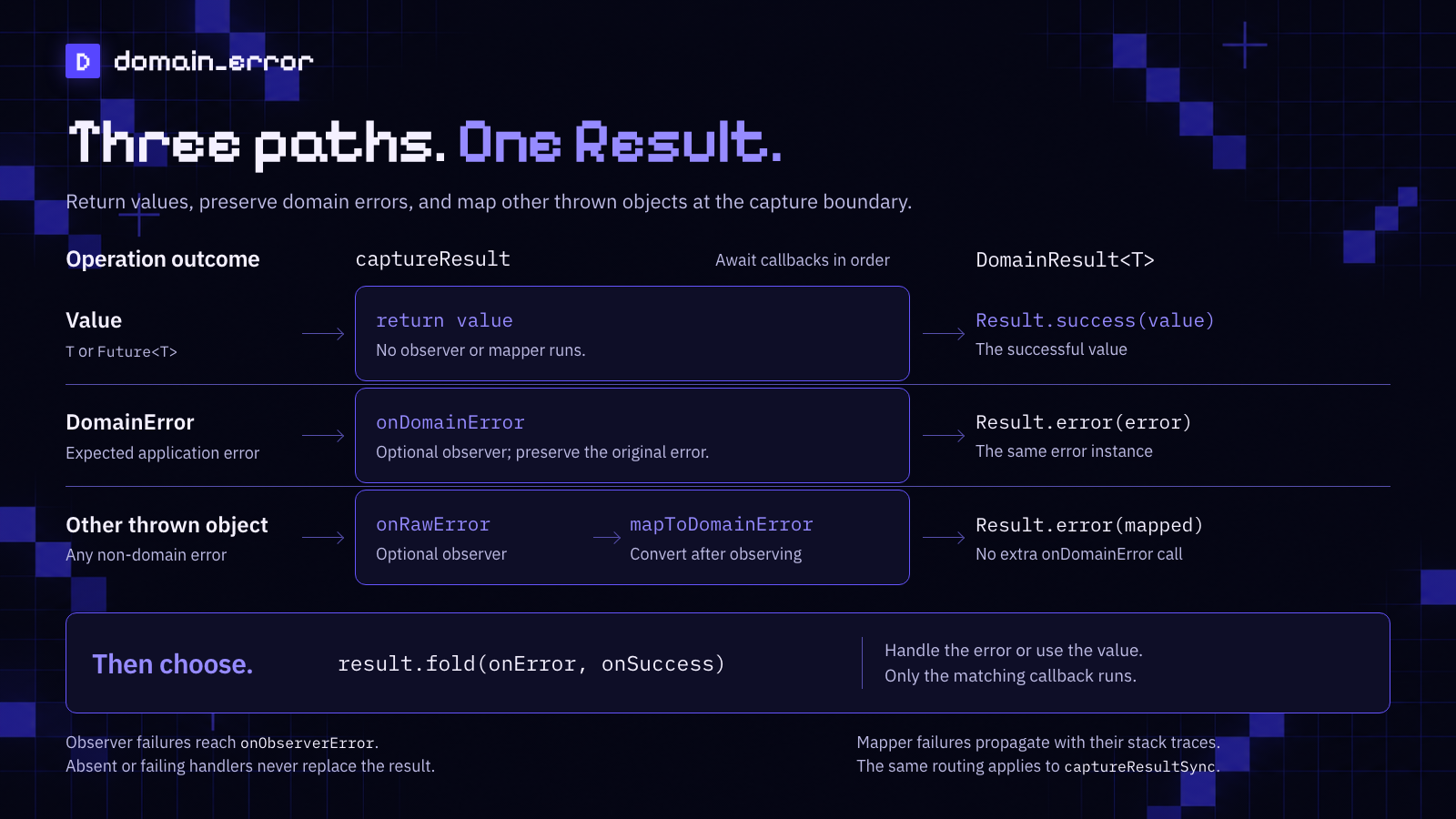
Both capture functions take the operation as the first positional argument and
require the named mapToDomainError callback. Observers are optional.
| Operation outcome | Order | Returned result |
|---|---|---|
| Value | No observer or mapper | Result.success(value) |
Thrown DomainError |
onDomainError |
Result.error holding the same error instance |
| Other thrown object | onRawError, then mapToDomainError |
Result.error holding the mapped error |
The mapped error does not trigger onDomainError again. Observers receive the
caught stack trace. Stored diagnostic fields remain the mapper's responsibility;
capture preserves an existing domain error without filling or replacing its fields.
Synchronous capture and observation #
captureResultSync<T> returns DomainResult<T> immediately. The operation and
mapper are synchronous. All three observers return Null: an async function or
a void tear-off does not match the required type. Wrap a synchronous void
function in a block ending with return null, as below.
Observer failures reach optional onObserverError. Its absence or its own failure
never replaces the operation result, and it is not called recursively. A mapper
failure propagates; it is not an observer failure.
import 'package:domain_error/domain_error.dart';

/// Keeps a technical cause without making it part of error equality.
final class OrderUnavailableError extends DomainError {
  const OrderUnavailableError({
    super.cause,
    super.stackTrace,
  });

  @override
  String get typeIdentifier {
    return 'OrderUnavailableError';
  }
}

void main() {
  final events = <String>[];
  final trace = StackTrace.fromString('order.load');
  const original = OrderUnavailableError();
  final raw = StateError('warehouse unavailable');

  /// Uses the same boundary to demonstrate both error routes.
  DomainResult<int> capture(Object failure) {
    return captureResultSync<int>(
      () {
        Error.throwWithStackTrace(failure, trace);
      },
      mapToDomainError: (error, stackTrace) {
        events.add('map');
        return OrderUnavailableError(
          cause: error,
          stackTrace: stackTrace,
        );
      },
      onDomainError: (error, stackTrace) {
        events.add('domain');
        throw StateError('observer failed');
      },
      onRawError: (error, stackTrace) {
        events.add('raw');
        return null;
      },
      onObserverError: (error, stackTrace) {
        events.add('report');
        throw StateError('reporting failed');
      },
    );
  }

  final preserved = capture(original);
  final mapped = capture(raw);

  assert(identical(preserved.domainError, original));
  assert(identical(mapped.domainError.cause, raw));
  assert(identical(mapped.domainError.stackTrace, trace));
  assert(events.join(',') == 'domain,report,raw,map');
}
Return-type checks cannot prevent a synchronous observer from starting unawaited work internally. Use asynchronous capture when observation must await work.
Asynchronous capture #
captureResult<T> returns Future<DomainResult<T>>. It accepts FutureOr
callbacks and awaits the operation, selected observer, observer failure reporter
and mapper in order. This example verifies that reporting completes before mapping.
import 'package:domain_error/domain_error.dart';

/// Stores the original failure and trace supplied to the mapper.
final class OrderUnavailableError extends DomainError {
  const OrderUnavailableError({
    super.cause,
    super.stackTrace,
  });

  @override
  String get typeIdentifier {
    return 'OrderUnavailableError';
  }
}

Future<void> main() async {
  final events = <String>[];
  final raw = StateError('warehouse unavailable');

  final result = await captureResult<int>(
    () async {
      await Future<void>.delayed(Duration.zero);
      throw raw;
    },
    onRawError: (error, trace) async {
      await Future<void>.delayed(Duration.zero);
      events.add('raw');
      throw StateError('observer failed');
    },
    onObserverError: (error, trace) async {
      await Future<void>.delayed(Duration.zero);
      events.add('report');
    },
    mapToDomainError: (error, trace) async {
      await Future<void>.delayed(Duration.zero);
      events.add('map');
      return OrderUnavailableError(
        cause: error,
        stackTrace: trace,
      );
    },
  );

  assert(result.isError);
  assert(identical(result.domainError.cause, raw));
  assert(events.join(',') == 'raw,report,map');
}
Handle results #
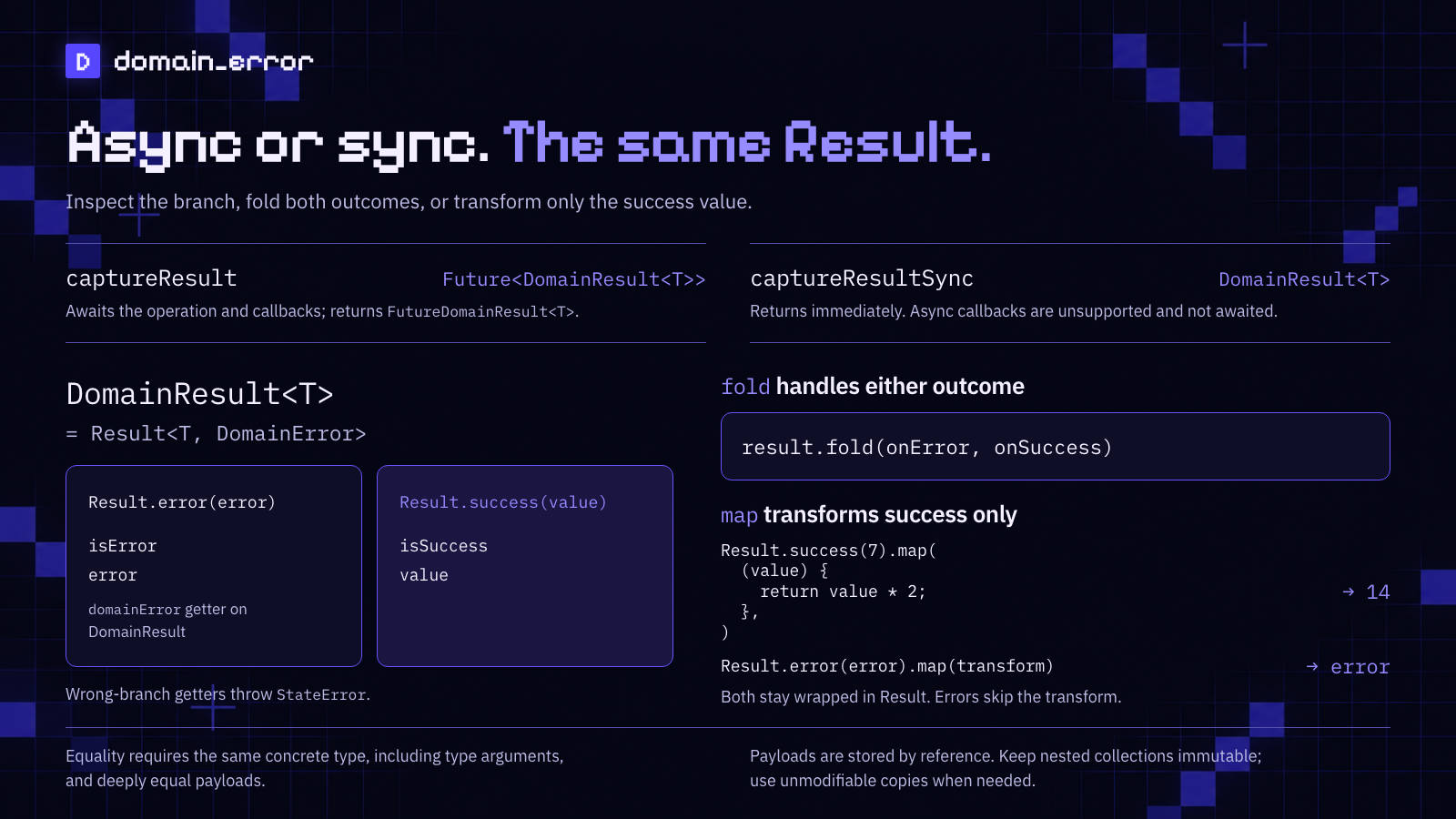
Result<T, E> is sealed, with ResultSuccess<T, E> and ResultError<T, E>
branches. Construct them with Result.success / Result.error or the concrete
branch constructors. These constructors are const when their payload is const.
The success type comes first.
Use fold(onError, onSuccess) or a switch to handle both branches. Only the
selected callback runs. isSuccess and isError test the branch. Reading
value from an error, or error from a success, throws StateError.
domainError is the error getter on DomainResult<T> and also throws on success.
A null payload is a valid success or error; branch identity does not depend on
whether the payload is null. A Result<void, E> can represent successful
completion without a useful value.
import 'package:domain_error/domain_error.dart';

/// Matches the public concrete branches with Dart 3 object patterns.
String describe(Result<int, String> result) {
  switch (result) {
    case ResultError(:final error):
      return 'Error: $error';
    case ResultSuccess(:final value):
      return 'Order $value';
  }
}

void main() {
  const success = Result<int, String>.success(42);
  const error = Result<int, String>.error('missing');
  const nullableSuccess = ResultSuccess<int?, String?>(null);
  const nullableError = ResultError<int?, String?>(null);
  const completed = Result<void, String>.success(null);

  final folded = success.fold(
    (error) {
      return 'Error: $error';
    },
    (value) {
      return 'Order $value';
    },
  );

  assert(folded == describe(success));
  assert(describe(error) == 'Error: missing');
  assert(success.isSuccess && success.value == 42);
  assert(error.isError && error.error == 'missing');
  assert(nullableSuccess.isSuccess && nullableSuccess.value == null);
  assert(nullableError.isError && nullableError.error == null);
  assert(nullableSuccess != nullableError);
  assert(completed.isSuccess);
}
Compose operations #
Composition selects one branch at each step. Skipped callbacks do not run; selected steps run once, in order. Unchanged payloads retain their references; wrapper identity is not a contract. Composition does not capture exceptions.
Map and chain successful values #
map<U> turns a successful value into a value of U. andThen<U> runs an
operation returning Result<U, E>, so it can choose success or error. Both skip
an existing error and preserve its payload.
import 'package:domain_error/domain_error.dart';

void main() {
  final events = <String>[];

  final total = const Result<int, String>.success(2).map(
    (quantity) {
      events.add('price');
      return quantity * 20;
    },
  ).andThen(
    (subtotal) {
      events.add('limit');
      if (subtotal > 100) {
        return const Result<int, String>.error('limit exceeded');
      }
      return Result<int, String>.success(subtotal);
    },
  );

  final skipped = const Result<int, String>.error('sold out').andThen(
    (quantity) {
      events.add('unexpected');
      return Result<int, String>.success(quantity);
    },
  );

  assert(total.value == 40);
  assert(skipped.error == 'sold out');
  assert(events.join(',') == 'price,limit');
}
Translate errors and recover #
mapError<F> changes the error type from E to F, preserving a success.
recover runs only for an error and returns another Result<T, E>. Return a
success for a selected fallback or an error to preserve or replace the failure.
Recovery preserves both type arguments; use mapError to change error vocabulary.
import 'package:domain_error/domain_error.dart';

/// A small application vocabulary for a boundary's numeric error codes.
enum OrderFailure {
  missing,
  unavailable,
}

void main() {
  final translated = const Result<int, int>.error(404).mapError<OrderFailure>(
    (code) {
      if (code == 404) {
        return OrderFailure.missing;
      }
      return OrderFailure.unavailable;
    },
  );

  final recovered = translated.recover(
    (error) {
      if (error == OrderFailure.missing) {
        return const Result<int, OrderFailure>.success(0);
      }
      return Result<int, OrderFailure>.error(error);
    },
  );

  var called = false;
  final unchanged = const Result<int, OrderFailure>.success(42).recover(
    (error) {
      called = true;
      return Result<int, OrderFailure>.error(error);
    },
  );

  assert(translated.error == OrderFailure.missing);
  assert(recovered.value == 0);
  assert(unchanged.value == 42 && !called);
}
Compose asynchronous work #
| Receiver | Methods | Callback completion | Return |
|---|---|---|---|
Result<T, E> |
map, andThen, mapError, recover |
Synchronous | Result |
Result<T, E> |
mapAsync, andThenAsync, mapErrorAsync, recoverAsync |
Awaited FutureOr |
Future<Result> |
Future<Result<T, E>> |
map, andThen, mapError, recover |
Source and selected FutureOr callback awaited |
Future<Result> |
On a future, the unsuffixed methods come from the public FutureResult<T, E>
extension. A chain needs one final await; call fold on the completed result.
The generic future has no FutureResult typedef. Use FutureDomainResult<T>
for the domain specialization or Future<Result<T, E>> for other error types.
import 'package:domain_error/domain_error.dart';

Future<void> main() async {
  final mapped = await const Result<int, String>.success(20).mapAsync(
    (value) async {
      return value + 1;
    },
  );
  final chained = await mapped.andThenAsync(
    (value) async {
      return Result<int, String>.success(value * 2);
    },
  );
  final translated = await const Result<int, int>.error(404).mapErrorAsync(
    (code) async {
      return 'HTTP $code';
    },
  );
  final recovered = await translated.recoverAsync(
    (error) async {
      return const Result<int, String>.success(0);
    },
  );

  final events = <String>[];
  final pipeline = await Future<Result<int, String>>.value(
    const Result.success(20),
  ).andThen(
    (value) async {
      events.add('chain');
      return Result<int, String>.success(value + 1);
    },
  ).map(
    (value) {
      events.add('map');
      return value * 2;
    },
  ).mapError(
    (error) {
      events.add('unexpected translation');
      return error;
    },
  ).recover(
    (error) async {
      events.add('unexpected recovery');
      return const Result<int, String>.success(-1);
    },
  );

  assert(chained.value == 42);
  assert(translated.error == 'HTTP 404');
  assert(recovered.value == 0);
  assert(pipeline.value == 42);
  assert(events.join(',') == 'chain,map');
}
The maintained composition example also combines capture, observation, nullable recovery and chaining.
Exceptions and asynchronous boundaries #
Callback failures and failed futures #
Observer failure isolation belongs to capture. Mapper failures propagate with
their original objects and stack traces. A thrown transform or recovery failure
also propagates. recover handles an error payload inside a result; it does not
handle a failed source future. Capture a throwing operation explicitly when its
failure should become a domain error.
import 'package:domain_error/domain_error.dart';

Future<void> main() async {
  final failure = StateError('callback failed');
  final trace = StackTrace.fromString('original callback trace');
  var recovered = false;
  var propagated = 0;

  try {
    captureResultSync<int>(
      () {
        throw StateError('operation failed');
      },
      mapToDomainError: (error, stackTrace) {
        Error.throwWithStackTrace(failure, trace);
      },
    );
  } on Object catch (error, stackTrace) {
    assert(identical(error, failure));
    assert(identical(stackTrace, trace));
    propagated++;
  }

  try {
    const Result<int, String>.success(42).map<int>(
      (value) {
        Error.throwWithStackTrace(failure, trace);
      },
    );
  } on Object catch (error, stackTrace) {
    assert(identical(error, failure));
    assert(identical(stackTrace, trace));
    propagated++;
  }

  try {
    await Future<Result<int, String>>.error(failure, trace).recover(
      (error) {
        recovered = true;
        return const Result<int, String>.success(0);
      },
    );
  } on Object catch (error, stackTrace) {
    assert(identical(error, failure));
    assert(identical(stackTrace, trace));
    propagated++;
  }

  assert(propagated == 3);
  assert(!recovered);
}
Late Future and Stream errors #
captureResultSync<T> stores its returned T unchanged. If T is a Future
or Stream, later errors occur outside that synchronous call. Likewise,
capturing the creation of a stream does not observe subscription errors.
Await the future or consume the stream inside an asynchronous capture boundary:
import 'package:domain_error/domain_error.dart';

/// Represents a failure observed while awaiting or consuming work.
final class OrderUnavailableError extends DomainError {
  const OrderUnavailableError({
    super.cause,
    super.stackTrace,
  });

  @override
  String get typeIdentifier {
    return 'OrderUnavailableError';
  }
}

Future<void> main() async {
  final failure = StateError('late failure');
  final trace = StackTrace.fromString('asynchronous operation');

  final pending = captureResultSync<Future<int>>(
    () {
      return Future<int>.error(failure, trace);
    },
    mapToDomainError: (error, stackTrace) {
      return OrderUnavailableError(
        cause: error,
        stackTrace: stackTrace,
      );
    },
  );

  final awaited = await captureResult<int>(
    () {
      return pending.value;
    },
    mapToDomainError: (error, stackTrace) {
      return OrderUnavailableError(
        cause: error,
        stackTrace: stackTrace,
      );
    },
  );
  final consumed = await captureResult<int>(
    () async {
      return await Stream<int>.error(failure, trace).first;
    },
    mapToDomainError: (error, stackTrace) {
      return OrderUnavailableError(
        cause: error,
        stackTrace: stackTrace,
      );
    },
  );

  assert(pending.isSuccess);
  assert(identical(awaited.domainError.cause, failure));
  assert(identical(consumed.domainError.cause, failure));
}
For a long-lived stream subscription, own error handling and cancellation at the subscription boundary. Capture is not a stream transformer or a zone-wide handler.
Equality and mutable payloads #
Result equality requires the same concrete branch and both type arguments,
plus deeply equal payloads. The payload comparison checks both directions.
For example, Result<int, String>.success(7) differs from
Result<num, String>.success(7), even though the numeric values compare equal.
Hashing includes the concrete result type and deep payload hash.
Result stores payloads by reference without copying them. Mutating a payload
can change equality and hashing and make an existing map key or set element
unfindable. An unmodifiable outer collection does not protect nested mutable
collections. Snapshot every mutable layer you own:
import 'package:domain_error/domain_error.dart';

void main() {
  final source = <String, List<int>>{
    'items': [1, 2],
  };
  final snapshot = Map<String, List<int>>.unmodifiable({
    for (final entry in source.entries) entry.key: List<int>.unmodifiable(entry.value),
  });
  final result = Result<Map<String, List<int>>, String>.success(snapshot);
  final results = {result};

  source['items']!.add(3);

  assert(identical(result.value, snapshot));
  assert(result.value['items']!.length == 2);
  assert(results.contains(result));
  assert(
    result ==
        Result<Map<String, List<int>>, String>.success({
          'items': [1, 2],
        }),
  );
  assert(
    const Result<int, String>.success(7) != const Result<num, String>.success(7),
  );
}
The same immutability discipline applies to domain error business fields in
props. Diagnostic fields excluded from equality do not make mutable business
payloads safe as keys.
Diagnostics and reporting #
DomainError.toString() uses typeIdentifier and the first non-empty description:
message, then cause. It trims whitespace and keeps the first line, recognizing
LF, CRLF and CR. A nested domain error contributes its identifier. An empty,
opaque or throwing cause description becomes unknown; without a description,
only the identifier remains. The original fields remain available.
This is display formatting, not redaction. Messages, causes, stack traces and
toString() output can contain private data. Define an allowlist for remote
reporting, and prepare user-facing messages separately from technical causes.
The package does not send reports or decide which fields are safe.
import 'package:domain_error/domain_error.dart';

/// Keeps the display message separate from technical diagnostic context.
final class OrderUnavailableError extends DomainError {
  const OrderUnavailableError({
    super.message,
    super.cause,
    super.stackTrace,
  });

  @override
  String get typeIdentifier {
    return 'OrderUnavailableError';
  }
}

void main() {
  final error = OrderUnavailableError(
    message: '  Try again later\nAdditional internal detail',
    cause: StateError('private diagnostic context'),
    stackTrace: StackTrace.current,
  );

  /// Only explicitly selected fields cross the reporting boundary.
  final report = <String, String>{
    'type': error.typeIdentifier,
    'operation': 'order.load',
  };

  assert(error.toString() == 'OrderUnavailableError(Try again later)');
  assert(error.message!.contains('Additional internal detail'));
  assert(report.length == 2);
  assert(report['type'] == 'OrderUnavailableError');
}
API map #
All entries are exported from package:domain_error/domain_error.dart.
| Public interface | Purpose and constraints |
|---|---|
DomainError |
Abstract Exception model; const constructor with optional message, cause, stackTrace |
typeIdentifier, message, cause, stackTrace |
Stable error vocabulary, description and diagnostic context |
props, equality, hashCode, toString() |
Business identity and diagnostic display; see the sections above |
Result<T, E> |
Sealed generic outcome, success type first; its unnamed base constructor is not directly instantiable |
Result.success(value), Result.error(error) |
Const factories for the two branches |
ResultSuccess<T, E>, ResultError<T, E> |
Const concrete constructors and object-pattern types; public value / error fields |
isSuccess, isError, value, error |
Branch predicates and checked branch access |
fold<U>(onError, onSuccess) |
Error callback first; returns the selected callback's U |
map<U>, andThen<U> |
Change the success type; preserve E |
mapError<F> |
Change the error type; preserve T |
recover |
Return another result on error; preserve T and E |
mapAsync, andThenAsync, mapErrorAsync, recoverAsync |
Await a selected FutureOr callback on an existing result |
FutureResult<T, E> |
Extension with unsuffixed composition methods on Future<Result<T, E>> |
DomainResult<T> |
Type alias for Result<T, DomainError> |
FutureDomainResult<T> |
Type alias for Future<DomainResult<T>> |
DomainResultError<T>.domainError |
Extension getter for the error of a domain result |
captureResult<T> |
Await an operation and callbacks; return Future<DomainResult<T>> |
captureResultSync<T> |
Run synchronous work; return DomainResult<T> without awaiting a future payload |
operation, mapToDomainError |
Required positional operation and required named mapper |
onDomainError, onRawError, onObserverError |
Optional domain/raw observers and isolated observer failure reporter |
Extension names matter for explicit extension overrides and show/hide
imports; ordinary instance syntax is usually sufficient. Read the
published API reference
for full signatures.
Compatibility #
The package declares Dart >=3.0.0 <4.0.0 and no Flutter SDK constraint. Dart 3
syntax is required by its class modifiers and patterns. A separate Flutter
consumer resolves the library without dependency overrides.
| Environment | Verification |
|---|---|
| Dart 3.0.0 | Minimum SDK: library checks, examples and README programs |
| Current stable Dart | Library checks, examples and README programs |
| Flutter 3.10.0 / Dart 3.0.0 | Consumer analysis/tests with normal and lowest runtime dependency resolution |
| Current stable Flutter | Consumer analysis/tests with its independent resolution |
The CI workflow
checks these endpoints. Flutter 3.10.0 resolves collection 1.17.1 and meta
1.9.1; its downgrade check also selects equatable 2.0.7. Intermediate SDK
versions are not each tested by this matrix. Platform declarations describe a
pure Dart library and are not physical-device test results.
The current API guide is for 5.x. The portable skill also maintains separate 3.x and 4.x contracts. Historical migrations below do not imply that every old package version was tested with every current SDK.
Migrate to 5.x #
Keep the package name and public import. The table maps legacy spelling to the current interface; choose the rows for your starting version. There are no compatibility aliases.
| Starting API | Current 5.x API |
|---|---|
2.x Either<L, R>, Either.err / Either.ok |
Result<R, L>, Result.error / Result.success |
2.x EitherErr<L, R> / EitherOk<L, R> |
ResultError<R, L> / ResultSuccess<R, L> |
2.x isErr / isOk, errValue |
isError / isSuccess, error |
2.x DomainError.rawError, including constructor forwarding |
cause, including super.cause |
2.x executeSafely / executeSafelySync |
captureResult / captureResultSync |
2.x ExecuteSafelyOptions / ExecuteSafelySyncOptions |
Move fields directly into named capture arguments; Options classes are removed |
2.x mapRawErrorToDomain |
mapToDomainError |
2.x positional method, fold parameters ifErr / ifOk |
operation, onError / onSuccess; positional call syntax stays the same |
3.x CaptureResultOptions / CaptureResultSyncOptions |
Move fields directly into named capture arguments |
3.x / 4.x Either<L, R>, Either.error / Either.success |
Result<R, L>, Result.error / Result.success |
3.x / 4.x EitherError<L, R> / EitherSuccess<L, R> |
ResultError<R, L> / ResultSuccess<R, L> |
2.x / 3.x / 4.x domain Result<T> / FutureResult<T> aliases |
DomainResult<T> / FutureDomainResult<T> |
2.x / 3.x / 4.x successValue; 3.x / 4.x errorValue |
value; error, including named pattern fields |
2.x / 3.x / 4.x ResultDomainError<T> |
DomainResultError<T>; domainError remains |
4.x FutureEitherOperations<L, R> |
FutureResult<R, L> extension; it is not a typedef |
Reorder both generic arguments, including inside collections, futures, bounds, casts, type tests, branch constructors and explicit extension overrides.
Review behavior as well as names:
- Upgrading from 2.x: observer failures are isolated, optional
onObserverErrorreceives them, and a failure in that reporter does not recurse. Diagnostics no longer affect default domain error equality. Different concrete generic result types compare unequal; payload comparison is symmetric. Description formatting consistently uses one line and tolerates failing causes. - Upgrading from 3.x or earlier: synchronous observers return
Null. Wrap synchronousvoidfunctions; choose async capture for asynchronous observers. Composition provides explicit Async methods on a result and unsuffixed methods on a result future. Recovery returns another result with the same types. - Upgrading from 4.x: 5.0 changes names and generic ordering while retaining capture and composition behavior, nullable/void payloads, stable identifiers and the SDK minimums.
Keep typeIdentifier strings, messages and diagnostic context when renaming
classes. Do not use runtime type names or hash codes as persisted identity.
The two historical wrong-branch StateError messages remain
Either.success has no errorValue and Either.error has no successValue;
these strings are diagnostic text, not compatibility APIs.
For historical detail, see the 3.0 changelog, 3.x to 4.0 guide and 4.x to 5.0 guide. The 4.0 migration program uses its historical API; run current examples against 5.x.
Package skill #
Install the portable flutter-domain-errors guidance:
npx skills add andrey-krasheninnikov/domain_error --skill flutter-domain-errors
Installation is project-local by default. Add --agent codex claude-code to
select those clients or --global for user-wide installation. The existing
skills CLI needs a compatible Node.js
installation; there is no separate npm package to install.
The skill covers pure Dart and Flutter with separate 3.x, 4.x and 5.x references. It checks the applicable package's direct dependency and resolved API, including path/Git sources, before choosing rules. Older, newer or unresolved APIs require source inspection. It does not silently upgrade dependencies, migrate untouched code or impose application architecture.
Automatic selection depends on client support and task relevance. Installation alone does not establish selection. The validation notes name the exercised client versions, scenarios and limits.
Development #
From a checkout with the selected Dart SDK on PATH:
make deps
make check
dart run example/domain_error_example.dart
dart --enable-asserts run example/composition_example.dart
python3 -B -m unittest discover -s tool/readme_checks
python3 -B tool/readme_checks/check.py
make publish-dry-run
make check runs formatting checks, analysis and tests without rewriting source.
Use make format to apply the Dart 3.0 language style at a line length of 120.
The README checker requires Python 3.9 or later and uses its standard library.
It extracts every Dart block into a temporary package, analyzes and formats-checks
the programs, then runs them with assertions against this checkout. It also
checks local files, image descriptions and heading anchors. The Dart CI matrix
runs these checks on minimum and stable SDKs.
With Flutter 3.10.0 or current stable on PATH, run make flutter-deps, then
make flutter-check. To test the lowest runtime dependencies, run
flutter pub downgrade inside tool/flutter_consumer and repeat
make flutter-check from the root. This consumer has its own dependency
resolution and does not add Flutter to the published library.
Check portable skill examples with:
python3 -B -m unittest discover -s tool/skill_checks
python3 -B tool/skill_checks/check.py
Editable artwork lives in assets/cover.html, assets/overview.html,
assets/flow.html and assets/fold.html, sharing assets/readme-art.css.
Run make diagrams to export a 1600×640 cover and three 1600×900 diagrams.
The renderer uses isolated temporary Chrome profiles and local resources;
set CHROME_BIN to select Chrome or Chromium. The want dark artwork uses bundled
IBM Plex
and Pixelify Sans
fonts under their SIL Open Font Licenses.
Use GitHub Issues for defects or proposals. Public contract changes need tests and migration notes. Project vocabulary is in the glossary; architecture decisions record the reasoning behind identity, capture, composition and compatibility.
License #
MIT.
Metadata


Documentation
Publisher
unverified uploader
Weekly Downloads
Metadata
Domain errors with Result, DomainResult, and captureResult for expected errors in Dart applications.
Repository (GitHub)
View/report issues
Topics
#error-handling #domain #exceptions
License
 MIT (license)