
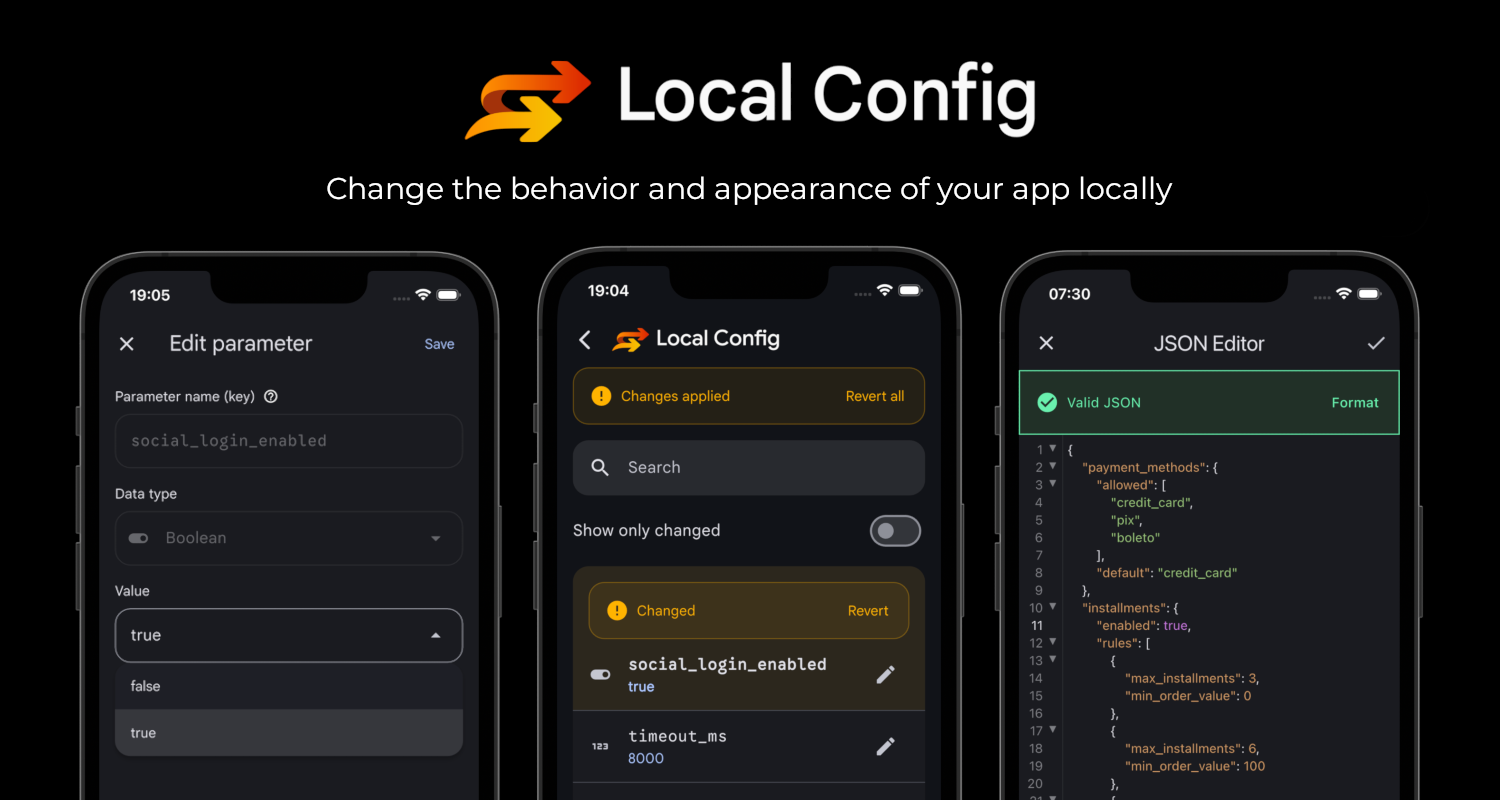


Make changes to your app's default behavior and appearance by changing parameter values — just like Firebase Remote Config, but locally. It’s designed for teams that need flexibility to override parameters, test feature flags, and simulate Remote Config behavior directly on their devices.
Features
The main goal is to provide the ability to manage configs locally for any purpose during development, testing, and even staging workflows.
- Familiar API inspired by Firebase Remote Config (
onConfigUpdated,getBool,getString, etc) - Built-in widget, also inspired by Firebase Remote Config, for viewing/editing parameter values
- Persistent parameter value overrides using
shared_preferencesorflutter_secure_storage
Getting Started
Add dependency
dependencies:
  local_config: ^0.2.3
Initialize with your parameters
import 'package:flutter/material.dart';
import 'package:local_config/local_config.dart';

void main() async {
  WidgetsFlutterBinding.ensureInitialized();

  await LocalConfig.instance.initialize(
    configSettings: LocalConfigSettings(
      keyValueStorage: SharedPreferencesKeyValueStorage(
        sharedPreferences: SharedPreferencesAsync(),
      ),
    ),
  );
  await LocalConfig.instance.setDefaults({
    'social_login_enabled': false,
    'timeout_ms': 8000,
    'animation_speed': 1.25,
    'api_base_url': 'https://api.myapp.com/v1',
    "checkout": {
      "payment_methods": {
        "allowed": ["credit_card", "pix", "boleto"],
        "default": "credit_card",
      },
      "installments": {
        "enabled": false,
        "rules": [
          {"max_installments": 3, "min_order_value": 0},
          {"max_installments": 6, "min_order_value": 100},
          {"max_installments": 10, "min_order_value": 300},
        ],
      },
    },
  });

  runApp(const ExampleApp());
}
Or with the FirebaseRemoteConfig parameters
import 'package:flutter/material.dart';
import 'package:firebase_remote_config/firebase_remote_config.dart';
import 'package:local_config/local_config.dart';

void main() async {
  WidgetsFlutterBinding.ensureInitialized();

  await FirebaseRemoteConfig.instance.fetchAndActivate();

  await LocalConfig.instance.initialize(
    configSettings: LocalConfigSettings(
      keyValueStorage: SharedPreferencesKeyValueStorage(
        sharedPreferences: SharedPreferencesAsync(),
      ),
    ),
  );
  await LocalConfig.instance.setDefaults(
    FirebaseRemoteConfig.instance.getAll().map(
      (key, value) => MapEntry(key, value.asString()),
    ),
  );

  runApp(const ExampleApp());
}
⚠️ Warning: When using
RemoteConfigValue.asString()from the firebase_remote_config package, the returned value may not always match the expected logical type. For example, boolean values may sometimes come as numeric strings ("0"or"1") instead of"true"or"false".
Navigate to built-in entrypoint widget
IconButton(
  onPressed: () {
    Navigator.of(context).push(
      MaterialPageRoute(
        builder: (_) => LocalConfigEntrypoint(),
      ),
    );
  },
  tooltip: 'Local Config',
  icon: const Icon(Icons.settings),
)
Get parameter values
final socialLoginEnabled = LocalConfig.instance.getBool('social_login_enabled');
final timeoutMs = LocalConfig.instance.getInt('timeout_ms');
final animatinoSpeed = LocalConfig.instance.getDouble('animation_speed');
final apiBaseUrl = LocalConfig.instance.getString('api_base_url');
final checkout = LocalConfig.instance.getString('checkout');
Or listen for updates (if your implementation supports it)
LocalConfig.instance.onConfigUpdated.listen((event) {
  print('Updated keys: ${event.updatedKeys}}');
});
For a full demo, check the example folder.
Additional Information
- Report issues or request features in the GitHub Issues
- Contributions are welcome! Feel free to open pull requests.